Konoka
English-speaking mental health clinics in Tokyo.
CLIENT
LINK
SERVICE
SCOPE

A self-initiated project: I researched, designed, and built it end to end, solo.
The problem
Foreigners in Tokyo struggle to find English-speaking mental health care — but not for the reason it first appears. The common assumption is that these services don't exist or don't advertise. What I found by doing the research firsthand was different: the resources largely do exist, but the system to reach them is unintuitive and effectively invisible to the people who need it.
The research
I researched this the way a user would have to — by becoming one. I contacted clinics directly to confirm whether doctors actually spoke English, visited some in person, and reached out to ward offices, which call back and recommend English-speaking clinics on request.
Two findings shaped the entire project:
First, most ward has English-speaking support available but a foreigner has no intuitive way to know the ward system is the path, or that they should ask. The information isn't missing; it's unreachable without knowing a system you have no reason to know exists.
Second, some clinics that ward offices actively recommended don't appear on Google Maps at all—meaning they're invisible to the exact discovery method a foreigner would instinctively try.
The problem was never absence of services. It was the absence of a bridge between a system that works and the people locked out of it.
The solution
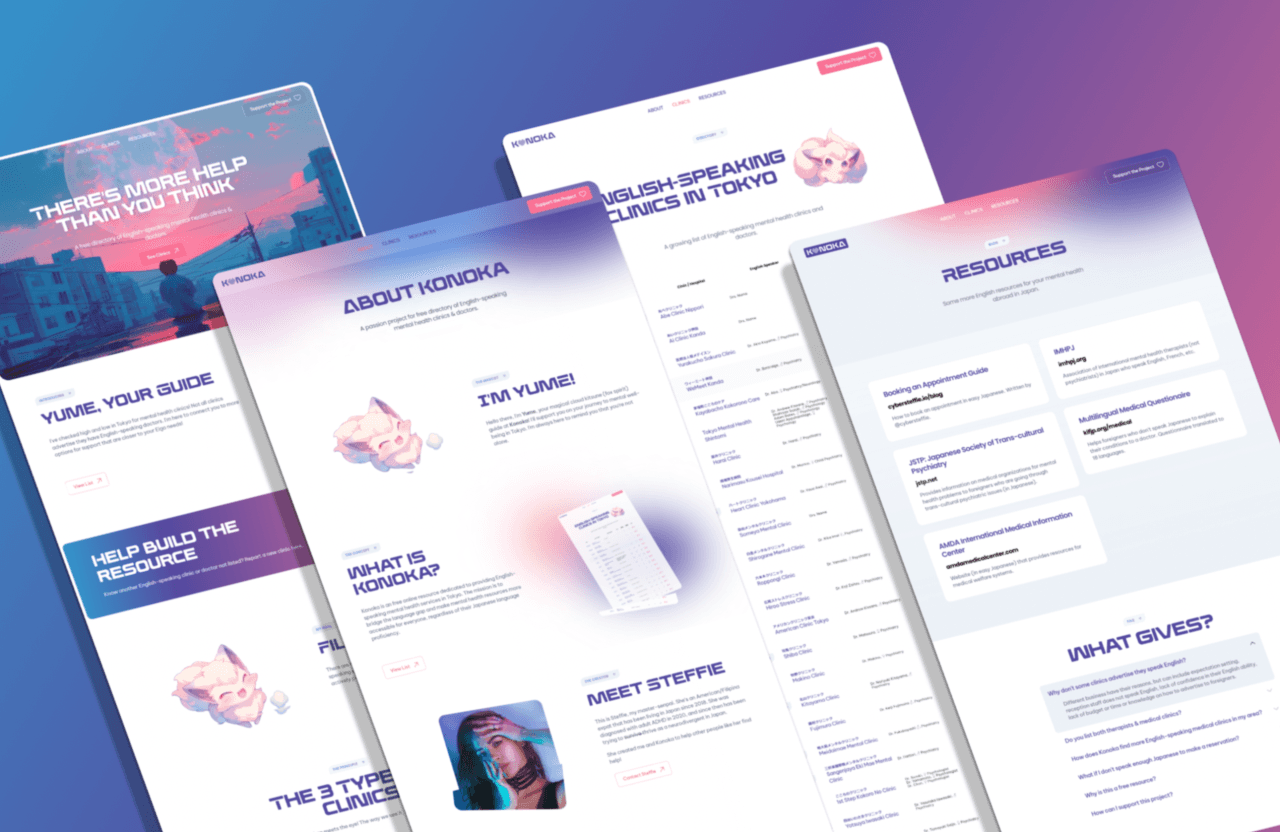
Konoka is that bridge: an English-first, personally-verified directory of mental health clinics in Tokyo. It doesn't generate information that doesn't exist — it consolidates and translates a fragmented, hard-to-reach system into something a non-Japanese speaker can actually navigate.
Every listing is verified by me directly — through contacting the clinic, visiting in person, or via ward office recommendations. Details are confirmed and added per clinic as I verify them, rather than scraped, which is what makes the directory trustworthy where scattered existing resources aren't. The directory currently holds around 30 clinics.
Design decisions
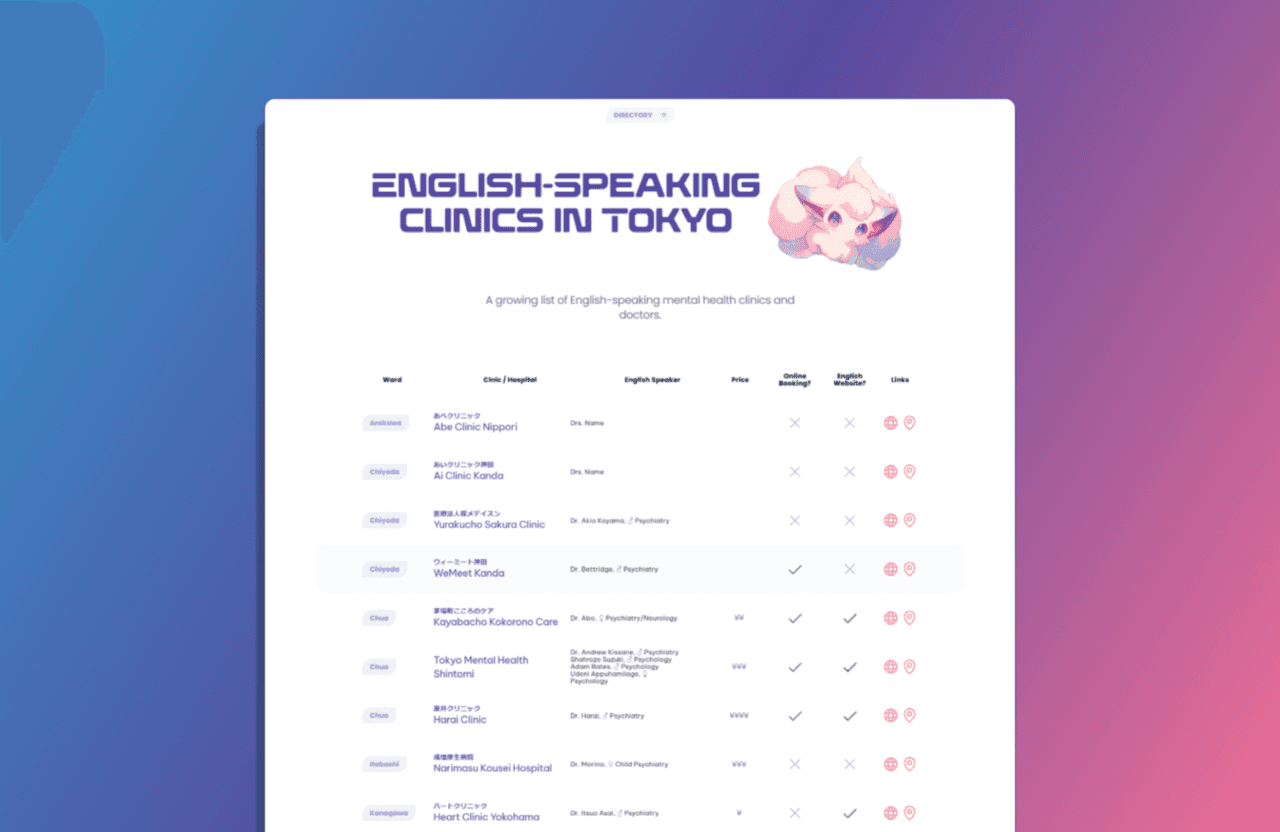
Directory structure | The core of the product is the directory schema. Each listing captures ward, clinic name, the specific English-speaking doctor (with specialty and gender), a price band, whether online booking exists, and whether the clinic has an English website. This is deliberate: a foreigner doesn't just need "a clinic" — they need to know a specific named person speaks English before they'll risk making contact. Naming the individual doctor removes the single biggest point of uncertainty in that first step. |
Price as a band, not a number | Cost is shown on a ¥–¥¥¥¥ scale rather than exact figures — enough for a user to gauge affordability without implying a quoted price for healthcare. |
Branding & mascot | The aesthetic is a deliberate emotional choice, not decoration. The vaporwave palette was chosen to communicate calm — a visual register that lowers the stakes of a stressful task. The anime mascot is an animal companion, drawing on the well-understood role of pets as mental-health symbols: presence, comfort, and the feeling of not being alone. For a user who may be reaching out for help for the first time, the intent is for the product to feel like a companion through an intimidating process rather than a clinical database. The choice is targeted, not flippant: it's designed to feel welcoming specifically to the people most likely to hesitate before seeking care. |
Information architecture | A flat five-page structure: |
Honest limitations & what's next
The directory is intentionally a growing, validated resource rather than a complete one — some listings have fields still being confirmed, and coverage expands as I verify each clinic. Planned next steps: search and sorting within the directory, and merch options to support the project's longevity.
Behind the Name
"Konoka" is a contraction of Kokoro no Kakurega (心の隠れ家) — "heart's hiding place," or safe haven.
Other
work